Publications
Journal articles and conference presentations.
Journal articles and manuscripts
In preparation
- Lateralized Cortical Activity during the Development of Role-Differentiated Bimanual ManipulationIn preparation
-
- Comparison of Spontaneous Movement Measurements Using Video Observation and Inertial Measurement Units (IMUs) in Typically Developing Infants and Infants at Risk for Cerebral PalsyIn preparation
- Characterizing Upper-Limb Force Control and Its Underlying Neurophysiological Correlates in Neurotypical AdultsIn preparation
2026
- Comparative Effectiveness of Early Therapies for Infants and Young Children with or at-risk for Cerebral Palsy: A Network Meta-analysis2026Under review, Neurorehabilitation and Neural Repair
In plain words: Families of babies with or at risk for cerebral palsy can choose from many early therapies. This review pools results from published trials to compare how well those therapies work against each other.
- fNIRS Commons: An Open Dataset for Studying Cortical Activation during Spontaneous Movement in Infancy2026Under review, Neurophotonics
In plain words: A free, shared dataset that captures how brain activity changes while typically developing babies move on their own, waving their arms and kicking. It was recorded with a soft cap that measures brain activity with light (fNIRS), so other researchers can use it to answer their own questions about brain development during this time.
2024
- A Comparative Evaluation of Unilateral and Bilateral Sequential Lung Isolation for Vertebral Body Tethering: A Retrospective Propensity Matched AnalysisCureus, May 2024
In plain words: Vertebral body tethering is a spine surgery for teens with scoliosis that requires temporarily collapsing a lung. Teens who had a lung collapsed on both sides in turn needed more breathing support and stayed in the hospital about a day longer than those who had one side done, but both groups did well.
Conference presentations
2026
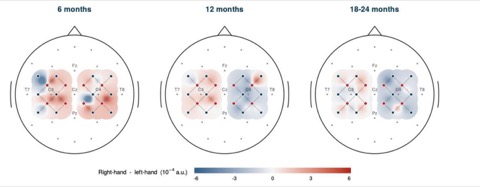
- Longitudinal Trajectories of Bilateral Hand Use: Changes in Behavior and Cortical ActivityIn American Academy for Cerebral Palsy and Developmental Medicine (AACPDM) 80th Annual Meeting, Sep 2026Scientific poster SP20
In plain words: Between 6 and 24 months, babies spent about the same share of playtime touching toys, but more of that touching used both hands, often with each hand doing a different job. Brain activity shifted to match, from both sides of the brain toward the side opposite the active hand.
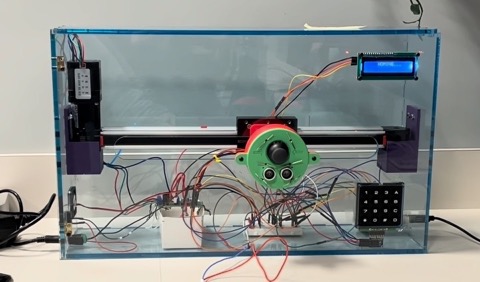
- Moving Target Board for Testing Online Motor ControlIn American Academy for Cerebral Palsy and Developmental Medicine (AACPDM) 80th Annual Meeting, Sep 2026Demonstration poster DP26
In plain words: A new device for testing how children correct a reach mid-movement: a real target on a motorized track jumps sideways as the child reaches for it, while a soft cap measures brain activity with light (fNIRS). It was built to understand how children control their reaches, including kids with cerebral palsy that affects one side of their body.
- Moderate Intensity Upper Limb Resistance Band Training Improves Neurophysiology in a Young Adult With Spastic Diplegic Cerebral Palsy: A Single Case Design StudyIn American Academy for Cerebral Palsy and Developmental Medicine (AACPDM) 80th Annual Meeting, Sep 2026Clinical observation poster CO18
In plain words: A young adult with cerebral palsy did moderate-intensity arm exercises with resistance bands. Afterwards, measures of how the brain and nerves control the arm improved, a promising first result from a single person.
- Feasibility of Using DeepLabCut for Markerless Motion Tracking During Infant ReachingIn American Academy for Cerebral Palsy and Developmental Medicine (AACPDM) 80th Annual Meeting, Sep 2026Scientific poster SP167
In plain words: Can free video-tracking software (DeepLabCut) follow babies’ arms as they reach for toys, with no markers or sensors on the body? This poster tested whether the approach is practical for infant studies.
2025
- Motor Experience Drives Brain Development: A Longitudinal Study of Infant Manual Skills and Cortical Activity in Neurotypical Infants and Infants with Unilateral Cerebral PalsyIn American Academy for Cerebral Palsy and Developmental Medicine (AACPDM) 79th Annual Meeting, Oct 2025Free paper R1
In plain words: We followed babies’ hand use during play and their brain activity as they grew, in babies developing typically and babies with cerebral palsy affecting one side of the body. The results suggest that babies’ own movement experience helps shape how the brain develops.
- Comparison of Spontaneous Movement Measurements Using Video Observation and Inertial Measurement Units (IMUs) in Typically Developing Infants and Infants at Risk for Cerebral PalsyIn American Academy for Cerebral Palsy and Developmental Medicine (AACPDM) 79th Annual Meeting, Oct 2025Free paper Q2
In plain words: Two ways to measure babies’ spontaneous movements, compared side by side: trained observers coding video, and small wearable motion sensors. The study included babies developing typically and babies at risk for cerebral palsy. The wearable sensors captured spontaneous movement acceptably well compared with video coding.
2024
- Exploring the Dynamics of Spontaneous Infant Movement: A Longitudinal Study of Movement Patterns and Cortical ActivityIn American Academy for Cerebral Palsy and Developmental Medicine (AACPDM) 78th Annual Meeting, Oct 2024Scientific poster SP169
In plain words: In their first months, babies wave their arms and kick on their own. This study followed babies over time to see how those movement patterns change and how they relate to brain activity.
- Spontaneous Movements and Cortical Activity during Early InfancyIn American Society of Neurorehabilitation (ASNR) Annual Meeting, Apr 2024Poster P120
In plain words: An early look at how young babies’ spontaneous movements, like waving and kicking, relate to activity in the brain during the first months of life.