Brain, body and a new apparatus. Combining fNIRS with a custom moving-target reaching board.
Children with unilateral cerebral palsy often have difficulty integrating sensory feedback with movement in their affected arm. To understand why, I combine two non-invasive techniques during reaching tasks:
TMS (transcranial magnetic stimulation) to assess corticospinal tract connectivity
fNIRS (functional near-infrared spectroscopy) to measure sensory cortical responses
Why the pathways matter
Each hemisphere of the brain starts out connected to both hands. As the brain matures, only the connections to the opposite hand remain. An early injury to one hemisphere, as in unilateral cerebral palsy, can change how these pathways develop, and TMS lets us see which ones are there. Switch between the stages below, then try a TMS pulse:
TMS
Immature motor tractsMature motor tractsAtypical ipsilateral motor tracts
Fig. 2a. How the brain's motor pathways to the hands develop, and what a TMS pulse reveals about them. Diagram: DEMR Lab, Boston University.
A moving target you can actually touch
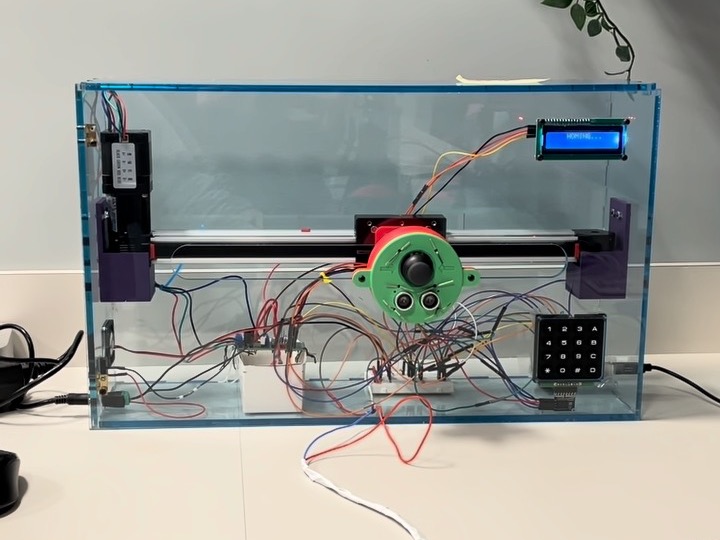
Reaching for a moving target requires constant correction based on what you see and feel. Most studies of this “online” motor control use targets on a screen, which lack the touch and depth cues of reaching for a real object. So I designed a physical moving-target board, built with Julia Zayas (Boston University College of Engineering, Class of 2027), the project’s lead engineer.
Fig. 2b. One trial of the task. Left: seen from above, the target jumps when the hand is 35% of the way there, and the hand has to correct mid-reach (dashed line: the original path). Right: how far the target and hand have shifted toward the target's new position, and what we measure from that correction. Drag the timeline or pick a step to explore. Timings are illustrative.
A child reaches from a home button toward a joystick target on a motorized track. When the hand is 35% of the way there, an ultrasonic sensor tracking the hand triggers the target to shift about 10 cm left or right. We measure correction latency, movement time and success rate, while fNIRS records cortical activity. Children reach with both their affected and unaffected arm.
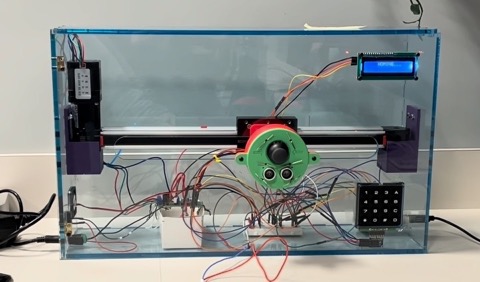
Fig. 2c. The board: the joystick target and its ultrasonic sensor ride on an enclosed motorized track. Still from the video demo.
To our knowledge, it is the first physical moving-target apparatus for assessing online motor control in children with CP alongside neuroimaging. Next steps are establishing its reliability and testing whether it can be used for training.
In American Academy for Cerebral Palsy and Developmental Medicine (AACPDM) 80th Annual Meeting, Sep 2026
Demonstration poster DP26
In plain words: A new device for testing how children correct a reach mid-movement: a real target on a motorized track jumps sideways as the child reaches for it, while a soft cap measures brain activity with light (fNIRS). It was built to understand how children control their reaches, including kids with cerebral palsy that affects one side of their body.
Children with unilateral cerebral palsy (UCP) demonstrate impairments in online motor control, particularly difficulty adjusting reach trajectories in response to target perturbations. Current assessments predominantly use screen-based virtual targets, which may not fully replicate the sensorimotor demands of physical reaching, limiting ecological validity and generalizability to functional activities. Our objective is to demonstrate a novel physical moving target apparatus designed to assess online motor control in children with UCP, integrating real-time target perturbation with concurrent functional near-infrared spectroscopy (fNIRS) to examine cortical activity. The apparatus consists of a horizontal target board (approximately 60 cm wide) with a linear track and enclosed motorized target system. Children and adolescents (ages 6-17 years) are seated with target distance individually normalized to 70-80% of comfortable reach based on arm length. Participants initiate a reach from a home button toward an illuminated target. When the hand reaches 35% of the distance to target (approximately peak reach velocity), a camera-based position-tracking system triggers the target to shift laterally by ±10 cm at 24 cm/s, requiring rapid online trajectory adjustment. This paradigm challenges core components of online sensorimotor integration: visual monitoring, proprioceptive updating, and motor planning. Participants complete reaches with both affected and unaffected limbs under static and dynamic target conditions. Concurrent fNIRS captures cortical activation patterns to examine neural correlates of online motor control. The system features child-safe design with enclosed moving components and age-appropriate reach distances. Physical reaching tasks engage haptic and proprioceptive cues not captured by screen-based paradigms, enhancing ecological validity. Findings may better predict functional outcomes in daily activities such as grasping toys or catching objects which are skills essential for children with CP in activities of daily living and play. This strengthens lab-to-clinic translation. Integrating physical reaching with neuroimaging enables examination of cortical activation during realistic sensorimotor challenges. This may reveal neural signatures distinguishing successful from unsuccessful trajectory adjustments and identify mechanisms underlying motor control deficits in CP. Clinically, the apparatus may inform intervention planning by identifying which components of online motor control—visual feedback processing, trajectory planning, or motor execution—are most impaired. To our knowledge, this is the first physical moving target apparatus developed to assess online motor control in children with CP using concurrent neuroimaging. Future research will establish test-retest reliability, examine predictive validity for functional outcomes, and explore whether training yields intervention benefits.
@inproceedings{yarnall2026board,title={Moving Target Board for Testing Online Motor Control},author={Yarnall, Evan and Zayas, J. and Ferre, C. L.},booktitle={American Academy for Cerebral Palsy and Developmental Medicine (AACPDM) 80th Annual Meeting},address={Philadelphia, PA},year={2026},month=sep,note={Demonstration poster DP26},}