Sensorimotor development in infants at risk for CP
A longitudinal study following infants from 6 to 24 months. The focus of my dissertation.
How does sensorimotor development unfold in infants who are at risk for cerebral palsy, and when does it start to diverge from typical development?
My dissertation examines this with a longitudinal dataset that follows typically developing infants and infants at risk for cerebral palsy from 6 to 24 months. I analyze the data using R, MATLAB and Python.
Building the baseline: how bimanual skills develop
To know what to compare against, we first mapped how typically developing infants learn to use their two hands together. Infants start by using both hands for the same purpose, and later learn role-differentiated bimanual manipulation, where each hand does a different but complementary job, like pulling apart the pieces of a toy, or holding a container steady with one hand while the other opens it or puts things inside.
We filmed semi-structured play sessions every 3 months from 6 to 24 months, coded every bout of toy contact in Datavyu, and recorded brain activity over sensorimotor cortex with fNIRS at the same time.
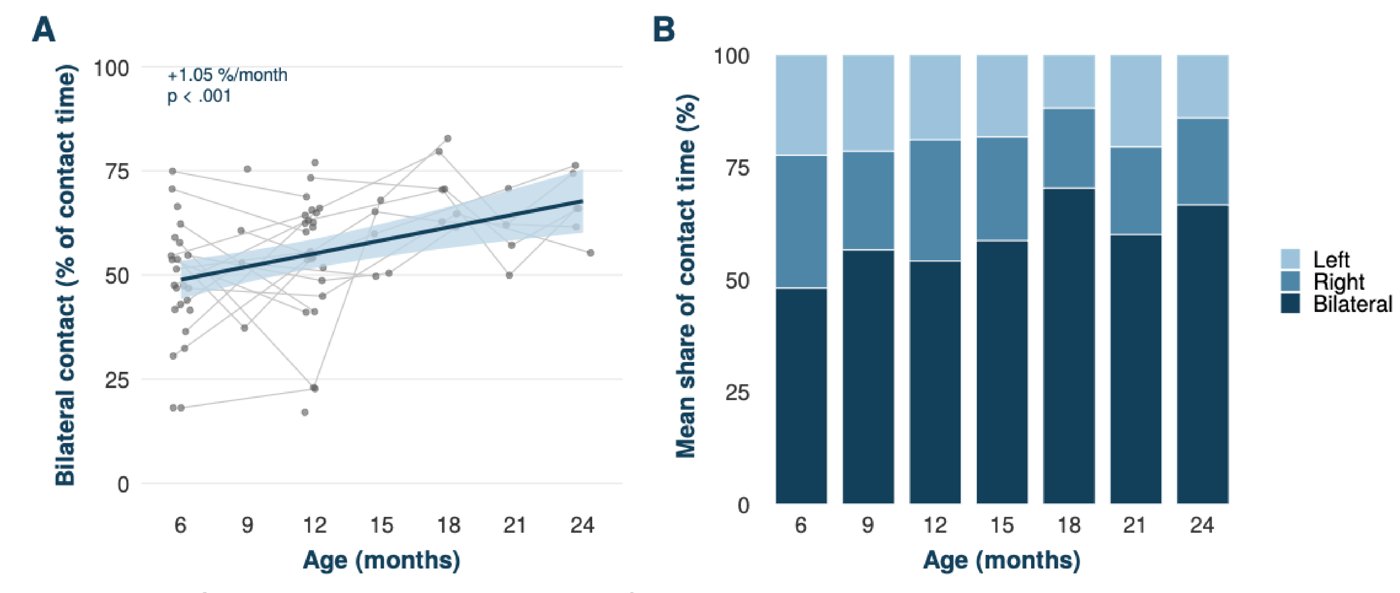
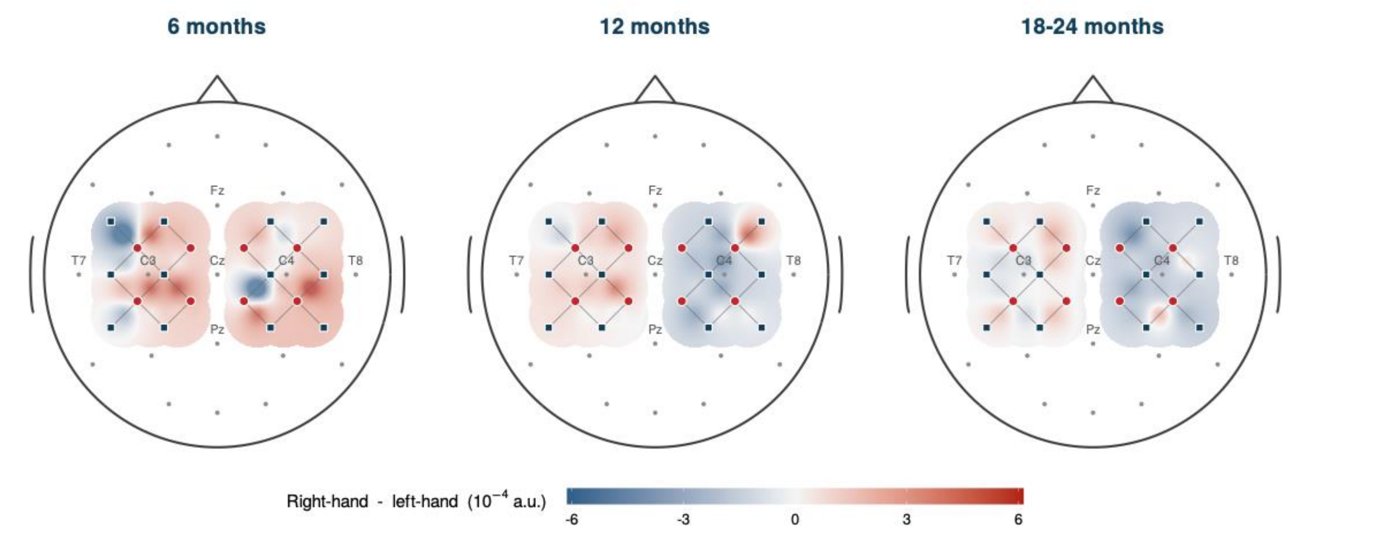
Fig. 1a. Manual exploration becomes increasingly bilateral between 6 and 24 months.Fig. 1b. fNIRS topography during role-differentiated bimanual manipulation. Cortical activity becomes more lateralized to the hemisphere opposite the active hand with age.
Infants spent about the same amount of time touching toys at every age, but how they used their hands changed: bilateral contact and role-differentiated manipulation both increased, and cortical activity shifted from bilateral to contralateral patterns. Next, we will compare these patterns in infants at risk for cerebral palsy.
Try it: watching the brain respond
fNIRS shines near-infrared light through the scalp to track oxygenated blood in the cortex underneath. When a brain area works harder, fresh oxygenated blood flows in, but only after a delay of several seconds. Squeeze below and watch for it.
squeezing hand
age
or hold the space bar
Fig. 1c. Hold the button to "squeeze" with one hand, then watch the fNIRS signal: oxygenated blood (HbO) rises seconds after the movement starts. Early in life, the brain has connections to both hands: ipsilateral (same side) and contralateral (opposite side). As the brain matures in typical development, only the contralateral connections remain, which is why each hemisphere controls the opposite hand. In unilateral cerebral palsy, an early injury to one hemisphere can change this: the uninjured hemisphere may keep ipsilateral connections to the affected hand. Change the age to watch the response become contralateral, the pattern in our AACPDM 2026 poster. Simulated, not real data.
In American Academy for Cerebral Palsy and Developmental Medicine (AACPDM) 80th Annual Meeting, Sep 2026
Scientific poster SP20
In plain words: Between 6 and 24 months, babies spent about the same share of playtime touching toys, but more of that touching used both hands, often with each hand doing a different job. Brain activity shifted to match, from both sides of the brain toward the side opposite the active hand.
Infants’ manual interactions undergo drastic shifts during the first two years of life. Specifically, there are changes in bimanual object manipulation where young infants use both hands together for the same purpose and older infants start coordinating hands to different but complementary tasks. This advanced skill is known as role-differentiated bimanual manipulation (RDBM). Understanding the developmental trajectories of these bimanual skills and the corresponding changes in brain development could provide potential intervention targets for improving these skills in children at risk of cerebral palsy (CP). The aim of this study is to evaluate the bimanual behavior patterns in relation to cortical activity in typically developing (TD) infants. We hope to provide a paradigm and baseline for comparison with infants at risk of CP. Experimental tasks were conducted with a cohort of 20 TD infants in a child-friendly laboratory environment. We used a longitudinal prospective design. Children were presented with toys during semi-structured play sessions every 3 months from 6 to 24 months. Each session was recorded with two cameras and bouts of contact with the toy and type of contact were coded using Datavyu. Video recordings were synched with functional near-infrared spectroscopy (fNIRS) acquisition. Cortical activity was measured using an fNIRS probe located over sensorimotor areas. A linear mixed effects model was used to evaluate the relationship between age and percentage of the session in contact with the toy, the percentage of contact that was bimanual, and the percentage of bimanual contact that was role-differentiated. A total of 46 sessions were completed. Percentage in contact with toys was stable: 70.6% (SD=15.3) at 6 months and 68.4% (SD=16.7) at 24 months; age accounted for 1.5% of variance. In contrast, percentage of bilateral contact increased from 49.9% (SD=13) to 67.2% (SD=7.6), showing 0.89%/month increase (95% CI:[0.24,1.4], p=0.009; marginal R²=10.3%, conditional R²=58.1%). RDBM as percentage of bilateral contact increased from 24.5% (SD=11.8) to 34.7% (SD=13.4), showing 1.21%/month increase (95% CI:[0.53,1.89], p=0.001; marginal R²=21.2%, conditional R²=31.5%). Cortical activation shifted from bilateral to contralateral patterns during RDBM. The percentage of the session in contact with the toy remained relatively stable across ages however the ways in which the infants engaged with toys changed. Infants showed increased bilateral contact and greater role-differentiated bimanual manipulation with age. Cortical activity reflected this upshift in asymmetric bimanual activity with a shift from bilateral activation to more activation contralateral to the active hand. These findings provide insights into how developmental changes allow infants to access new affordances of toys and are reflected in cortical activation in TD infants. Future work will characterize these developmental patterns in infants at risk for CP.
@inproceedings{yarnall2026bilateral,title={Longitudinal Trajectories of Bilateral Hand Use: Changes in Behavior and Cortical Activity},author={Yarnall, Evan and Kelly, M. and Kim, H. and Su, X. and Ferre, C. L.},booktitle={American Academy for Cerebral Palsy and Developmental Medicine (AACPDM) 80th Annual Meeting},address={Philadelphia, PA},year={2026},month=sep,note={Scientific poster SP20},}
Motor Experience Drives Brain Development: A Longitudinal Study of Infant Manual Skills and Cortical Activity in Neurotypical Infants and Infants with Unilateral Cerebral Palsy
In American Academy for Cerebral Palsy and Developmental Medicine (AACPDM) 79th Annual Meeting, Oct 2025
Free paper R1
In plain words: We followed babies’ hand use during play and their brain activity as they grew, in babies developing typically and babies with cerebral palsy affecting one side of the body. The results suggest that babies’ own movement experience helps shape how the brain develops.
@inproceedings{yarnall2025motor,title={Motor Experience Drives Brain Development: A Longitudinal Study of Infant Manual Skills and Cortical Activity in Neurotypical Infants and Infants with Unilateral Cerebral Palsy},author={Yarnall, Evan and Su, X. and Kim, H. and Kelly, M. and Ferre, C. L.},booktitle={American Academy for Cerebral Palsy and Developmental Medicine (AACPDM) 79th Annual Meeting},address={New Orleans, LA},year={2025},month=oct,note={Free paper R1},}